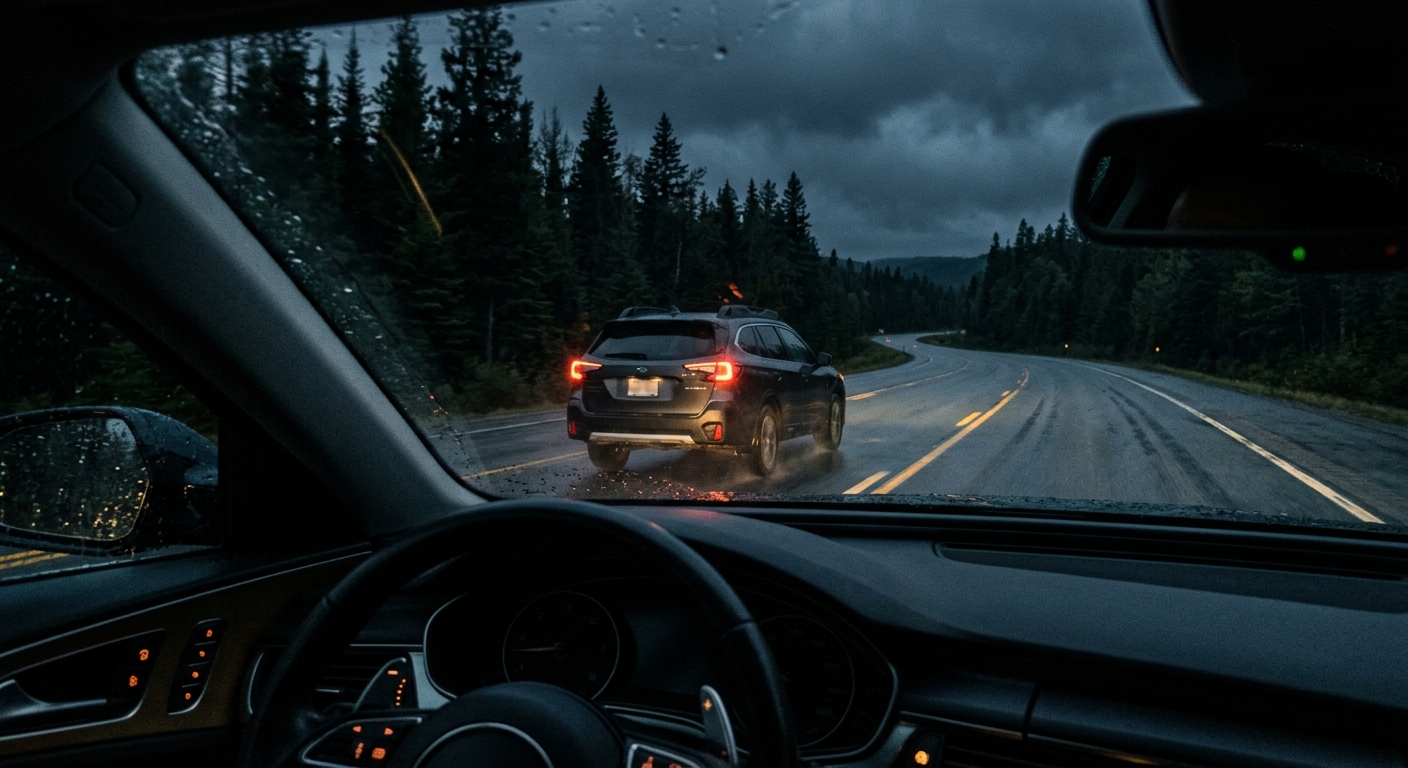
Following Distance & the Myth of Saving Time
Tailgating and speeding both run on the same assumption: that closing the gap, one way or another, gets you there meaningfully faster. It’s an intuitive belief, and it’s also one of the most thoroughly measured myths in traffic research. The real math — and real studies of real drivers — tell a very different story.

I used to assume speeding got me there faster, until I actually timed it on a route I drove every day. It didn’t. Same lights, same stop signs — the gap I closed just opened right back up at the next red light.
The Real Math
is what a multi-week study of over 100 real drivers found the average driver actually saves per day by speeding — roughly 2 minutes a week, once real traffic, lights, and stops are factored in.
Even in pure theoretical terms, without any traffic at all, the gains are smaller than most people assume. Going 10 km/h over the limit on a typical commute-length drive saves only a few minutes — and the higher the speed limit already is, the less time an extra 10 km/h actually buys you, since the relationship between speed and time isn’t a straight line. Add real-world traffic lights and congestion, and most of that theoretical gain evaporates before you even reach the next intersection.
Why Tailgating Doesn’t Help Either
Following closely feels like it should get you through traffic faster, but it doesn’t change your average speed at all. Also see our guide on distracted driving — another habit that feels low-risk until it isn’t. All it actually does is remove your margin for reacting if the car ahead brakes suddenly, while the car ahead’s speed (not your following distance) is what actually determines how fast the whole line of traffic moves.
The Actual Cost of Closing the Gap
- Crash risk rises sharply with speed, not gradually — a small increase in speed disproportionately increases both the chance of a collision and its severity.
- Fuel economy drops fast at higher speeds — driving meaningfully over the limit can cut fuel efficiency by 15–20%, which adds up to real money over a year of driving.
- A conviction costs far more than the minutes saved — see our guide to demerit points and insurance consequences for what a single ticket can actually cost you over the following years.
The 3-Second Rule, and Why It Works
Pick a fixed point ahead. Count the seconds between the car ahead passing it and you reaching the same spot.
Pick a fixed point — a sign, a shadow, an overpass — and count the seconds between the car ahead passing it and you reaching the same spot. Three seconds in good conditions (more in rain, snow, or fog) gives you enough time to actually process a hazard and react, rather than just react on reflex. It costs you nothing in travel time, since you’re moving at the same average speed as the traffic around you either way — it only changes how much margin you have if something goes wrong.
A Mental Habit Worth Building
Next time the urge to close a gap or push the speed shows up, it’s worth doing the actual math in your head for ten seconds: how much time is this realistically buying me over the rest of this drive? For almost every real trip, the honest answer is somewhere between “none” and “under a minute” — and that’s before counting the risk, the fuel cost, or what a ticket would actually cost over the next few years.
The Bottom Line
The math isn’t close: closing the gap, whether by speeding or tailgating, buys you seconds to at most a couple of minutes on almost any real drive, while meaningfully raising your risk, your fuel cost, and your exposure to a conviction that follows you for years. Keeping your distance and driving the limit isn’t a compromise — it’s very close to the same trip, with a real safety margin attached for free. The same principle carries onto the highway: see our Highway Merging guide for how speed and space work together there too. And because the limit is only a ceiling, our safe speed guide explains how to choose the right speed for the conditions in front of you.
Know the rules that actually matter
Try a free practice test for your province and see how right-of-way and following distance actually get tested. With DriveReady, you can also unlock Supervised Drive, a practical tool to help develop driving skills through guided practice sessions.
★ Start Free Practice Test